Writing with Sharon Watson-Easy-to-use Homeschool Writing and Literature Curriculum

Navigation Menu

How to Convince an Audience: Opinion versus Persuasion

How to Convince an Audience: Opinion versus Persuasion

SHARON’S BLOG

You may be very good at expressing your opinions, especially when you want to change someone’s mind.

What you may not know is that if you truly want to change someone’s mind, you have to stop thinking about your opinion and start thinking about your audience.

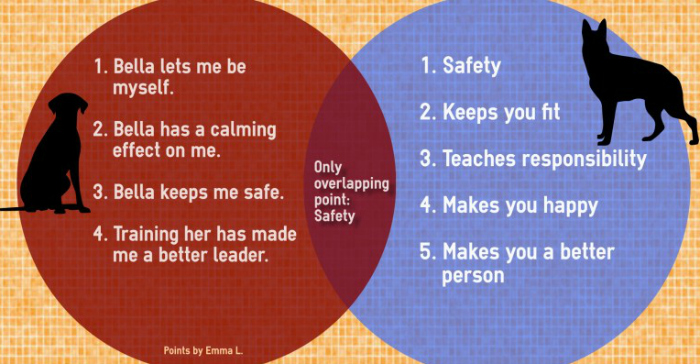
This tutorial, with a free infographic to download, will show you very clearly the difference between writing an opinion and writing to persuade an audience.

Opinion versus Persuasion

Writing or expressing an opinion is all about what you like; convincing another person to do something is all about what they need to hear to be persuaded.

Here’s an infographic that shows the difference between writing an opinion and writing to persuade. After the infographic, I’ve included a short writing exercise you can do quickly. My writing class just did it, and they had fun sharing their ideas about alligators, snow leopards, snakes, and so forth.

Read More

Writing Is Better When . . .

Writing Is Better When . . .

MIDDLE SCHOOL PROMPTS

Writing is hard. My students tell me this, and I believe them.

Writing makes their hands hurt. They don’t know what to write or how to write it. They have trouble coming up with topics. They’ll write if someone gives them a topic they are interested in. Or if someone gives them a topic, they don’t want to write.

Can you identify with any of these? If so, let’s make it easier on you.

Writing tip: When you are writing, be aware of your environment.

What do I mean by that? I mean be a detective and find out where you like to write and what you like around you when you write. Do you enjoy being in a room full of people, your favorite pet, or solid quiet when you write? Would you rather be at a desk . . . or slouched in the beanbag in the corner?

Read More

Never Do the Following

Never Do the Following

MIDDLE SCHOOL PROMPTS

Rules, rules, rules! You find them everywhere.

I even found some in a guide book to a Florida vacation area.

But these weren’t strictly rules. They were more like advice. In Emerald Coast Guide, I found all sorts of advice and things to avoid.

Quirky Beach Rules

For instance, in their “NEVER do the following” column, they mention some obvious things and some funny things:

Read More

Write a Story from an Animal’s Perspective

Write a Story from an Animal’s Perspective

HIGH SCHOOL PROMPTS

How do you write a story about Alaska before people arrived? You make animals the main characters, which is exactly what James A. Michener does in Alaska.

Michener creates Matriarch, a mammoth that is old enough to be the grandmother of many other mammoths. Through her eyes, we see the landscape and experience the early troubles of the area now known as Alaska.

An Alaskan Matriarch

Here’s a passage from Alaska in which Matriarch first encounters . . . well, I think you’ll figure out what’s going on here:

Read More

Fire Prevention Day—Narrowing Down a SubjectTopic

Fire Prevention Day—Narrowing Down a SubjectTopic

MIDDLE SCHOOL PROMPTS

Note: This is part one of the Intro to Writing series. Find links to the other tutorials here.

What do you do when your teacher gives you a subject to write about, but that subject is too broad?

For instance, what if your teacher says, “Write about natural disasters”? Right off the bat, you know you are in trouble. That subject is too large; there are too many possibilities. It would take a few books to cover everything, and your essay is due in two days.

Read More

Become a Poet

Become a Poet

MIDDLE SCHOOL PROMPTS

Has your sports team ever lost a game? And did you write about it in a poem?

You didn’t?

Well, Ernest Thayer did in the now-famous poem “Casey at the Bat.” You can read the history of the poem and the poem itself here.

October 2 is National Poetry Day, and recently the theme was “Remembering,” in which amateur and famous poets write to remember a special moment or a meaningful time in their lives.

Read More

Proofreading Marks and How to Use Them

Proofreading Marks and How to Use Them

SHARON’S BLOG

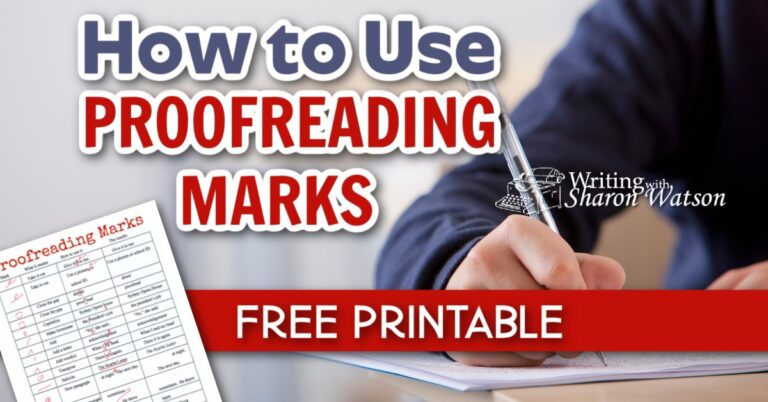
Do your students waste endless time erasing whole sentences? Do they become discouraged when they look at their rough drafts filled with arrows, illegible notes in the margins, and ugly lines of scratched-out writing?

I’ve watched students in my writing classes scratch out whole sentences and rewrite them. They draw lines through words. They burn up their papers and crumble their erasers just to change something.

This is totally unnecessary.

There’s an easierand quickerway to proofread that doesn’t require a lot of rewriting, which should be good news to our students.

Let’s save them the pain by teaching them these handy, easy-to-use proofreading marks.

Read More

Celebrate Comic Book Day!

Celebrate Comic Book Day!

MIDDLE SCHOOL PROMPTS

Yes, folks, September 25th is Comic Book Day!

“A day for good triumphing over evil, and for saving the damsel in distress, Comic Book Day is all about enjoying a good comic,” according to daysoftheyear.com.

The dialog in comic books has to be spot-on. It has to be clear, concise, exciting, and informative.

Dialog in comic books and in traditional books has three main purposes:

Read More

Apostrophe or no Apostrophe: It’s Confusing

Apostrophe or no Apostrophe: It’s Confusing

SHARON’S BLOG

confusingThis week’s grammar tutorial puts to rest some confusing words like “it’s” and “its.”

You can use the infographic below to teach your students about some confusing word usage. After that, there’s an exercise to reinforce the material with your students, and you’ll find the answers below the exercise.

Now, on to the tutorial . . .

Read More