What is important, though, is organizing the material, and that is where students have trouble. They do not want to take the time to organize their thoughts, ideas, or material before they write.
Personally, I benefit from even a casual outline. That way, I don’t have to start with the introduction and work my way down to the conclusion; I have the pleasure of beginning wherever I like, where I feel the most comfortable. Then I can fill in the rest of my article later by using the organized points in my informal outline.
Whether your students use sticky notes or a more formal outline, they’ll benefit from these familiar outline ideas.
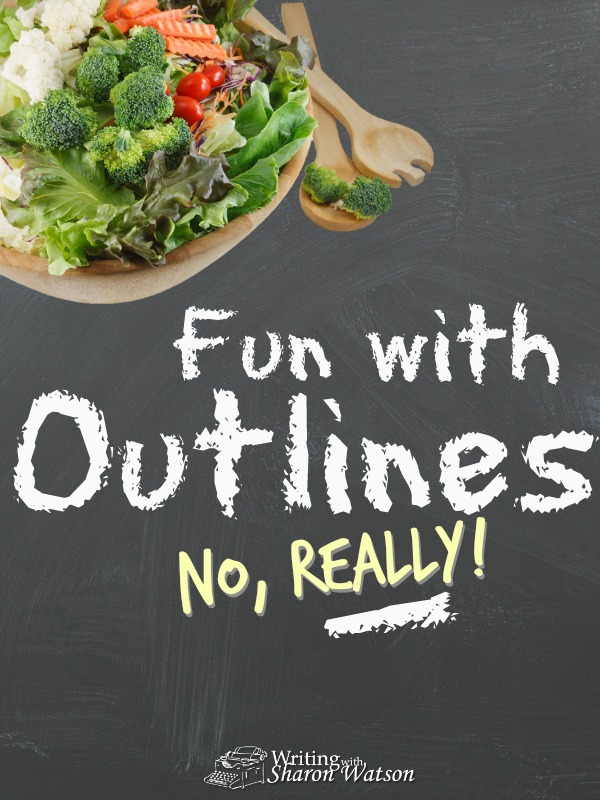
Instead of practicing an outline with difficult material, your students will use something they are familiar with. Grocery stores are organized in an orderly way; this will make outlining one easy-peasy.
On the free worksheet, your students will fill in a sample outline based on how a grocery store is organized. The worksheet already has the levels of a formal outline such as I, A, 1, a, and so forth.
Your students may want to extend the outline to include more grocery store departments. If so, they’ll use their own paper.
If they are not ready for a formal outline, let them use the sticky-note method .
Like the grocery store outline, your students will fill in a sample outline based on kinds of restaurants. The restaurants can be in your area, ones you’ve visited while traveling, or ones nationwide.
The worksheet already has the levels of a formal outline such as I, A, 1, a, and so forth. Your students may want to extend the outline to include more types of restaurants. If so, they’ll use their own paper.
If they are not ready for a formal outline, let them use the sticky-note method .
Intro to Writing, Part 3 takes some of the pain out of outlines by using material your students are already very familiar with: restaurant categories and the way grocery stores are organized. Grab it and the free printables here. >>
Part 4 features a tutorial on writing effective paragraphs. In it you’ll find a chart, an example paragraph written from the chart, and an empty chart your students can use again and again for their own paragraph constructions. Find this dandy tutorial for middle school students here. And the tutorial for teens, with an endangered Porcupine Park, can be found here.
Part 5 is a tutorial on point orders, with a link to a video explaining point orders. You can get it here. >>
SHARON’S BLOG Let’s give your students some practice in writing poetry! With these guided prompts, your students do not have to “sit down and write a poem” but will surprise you by creating something fun and maybe even memorable. Here goes . . .
HIGH SCHOOL PROMPTS There are many gut-wrenching parts to the death of Jesus and his resurrection. One is how Judas, a “friend” for three years, hands Jesus over to his enemies—with a sign of affection. Another is when Jesus willingly steps into a rigged trial, one He knows He will lose. Another troubling part of…
Did you know you shouldn’t spray Windex in your eyes or put your TV remote in the dishwasher? You did? Create your own warning to include on a product.
MIDDLE SCHOOL PROMPTS McDonald’s Big Mac. Burger King’s Whopper. Hardee’s Thickburger. Rally’s and Checker’s Big Buford. Is your mouth watering yet? Let’s celebrate hamburgers and cheeseburgers with a menu of writing prompt choices.
HIGH SCHOOL PROMPTS Today you get to be Shakespeare and write a sonnet. A sonnet is a poem of fourteen lines. The last two lines, however, are separate and either sum up the rest of the poem or provide a new twist, as does the sonnet below. Let’s look at Shakespeare’s Sonnet 62. The letters…
Read about Brittany Maynard’s decision to end her life because of her terminal brain tumor. Then read about Kara Tippett who is also dying from cancer. Write about these women and their decisions.