What is important, though, is organizing the material, and that is where students have trouble. They do not want to take the time to organize their thoughts, ideas, or material before they write.
Personally, I benefit from even a casual outline. That way, I don’t have to start with the introduction and work my way down to the conclusion; I have the pleasure of beginning wherever I like, where I feel the most comfortable. Then I can fill in the rest of my article later by using the organized points in my informal outline.
Whether your students use sticky notes or a more formal outline, they’ll benefit from these familiar outline ideas.
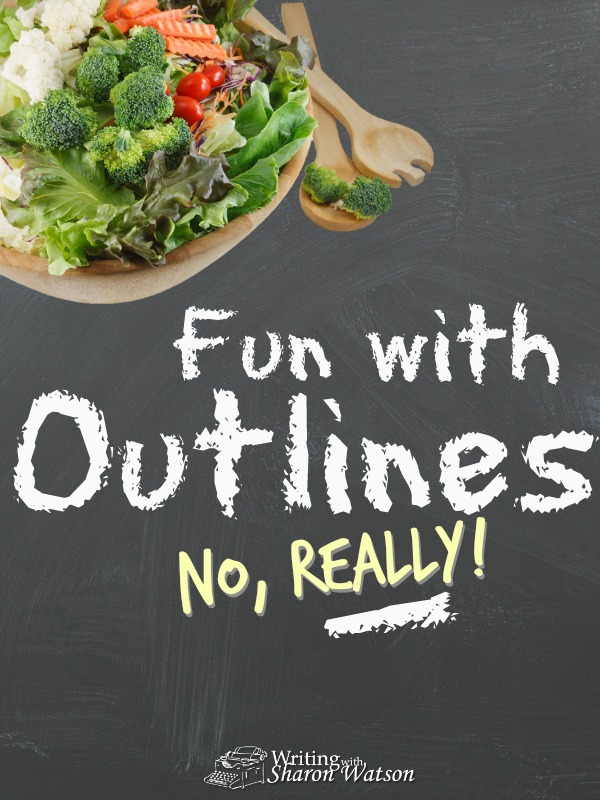
Instead of practicing an outline with difficult material, your students will use something they are familiar with. Grocery stores are organized in an orderly way; this will make outlining one easy-peasy.
On the free worksheet, your students will fill in a sample outline based on how a grocery store is organized. The worksheet already has the levels of a formal outline such as I, A, 1, a, and so forth.
Your students may want to extend the outline to include more grocery store departments. If so, they’ll use their own paper.
If they are not ready for a formal outline, let them use the sticky-note method .
Like the grocery store outline, your students will fill in a sample outline based on kinds of restaurants. The restaurants can be in your area, ones you’ve visited while traveling, or ones nationwide.
The worksheet already has the levels of a formal outline such as I, A, 1, a, and so forth. Your students may want to extend the outline to include more types of restaurants. If so, they’ll use their own paper.
If they are not ready for a formal outline, let them use the sticky-note method .
Intro to Writing, Part 3 takes some of the pain out of outlines by using material your students are already very familiar with: restaurant categories and the way grocery stores are organized. Grab it and the free printables here. >>
Part 4 features a tutorial on writing effective paragraphs. In it you’ll find a chart, an example paragraph written from the chart, and an empty chart your students can use again and again for their own paragraph constructions. Find this dandy tutorial for middle school students here. And the tutorial for teens, with an endangered Porcupine Park, can be found here.
Part 5 is a tutorial on point orders, with a link to a video explaining point orders. You can get it here. >>
SHARON’S BLOG Outlines. Did I lose you already? The idea of outlines and actually creating them can be confusing and frustrating to our students. But what if we could make organizing material a little easier for them? Intro to Writing, Part 3, shows students some fun and unusual ways to create outlines (organize their material)….
SHARON’S BLOGAn edict. A carol. A strange decoration. What do all these have in common? They are all part of our fun Christmas prompts. Enjoy these prompts created especially for 5th – 12th graders. Ho, ho, ho, and away we go . . .
Have you ever noticed how many songs use weather in their titles or in their lyrics? Often, this is a metaphor for a relationship or circumstance. Write your own song using the weather.
It’s easy to compare our homeschools with other educational experiences, but there’s no need to. If you feel inadequate, read this blog and feel cheered by Sharon’s experiences.
Grammar Lesson 16: When to use “I” and “Me” Song lyrics are notorious for misusing I and me. Here’s what I mean: I gaze into the starry skyAnd dream each night of you and I. This corny yet grammatical travesty happens so often that it barely scratches our ears any more. You already know when…
When was the last time your shoes talked to you? By using anthropomorphism, meaning “in the form of a human,” you can make objects or animals talk, plan, cry, and do other things humans do.