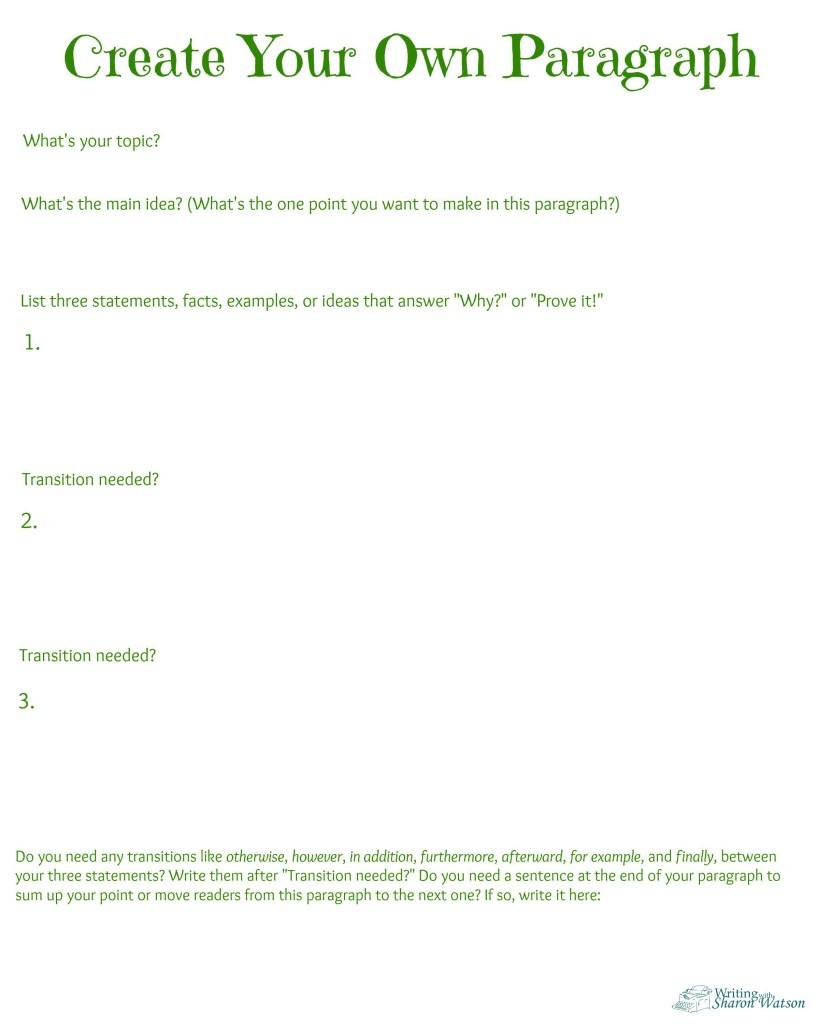
A paragraph is all about one idea. In it, you teach something about that idea, explain it, or prove why it is the right one. One effective question to ask yourself is “What do I want my reader to know about this topic?”
A Note: When one student used this chart to write a paragraph about a type of shark, she saw that she needed a section in her paragraph to describe the shark’s appearance. So she added that between the main idea and the first statement.
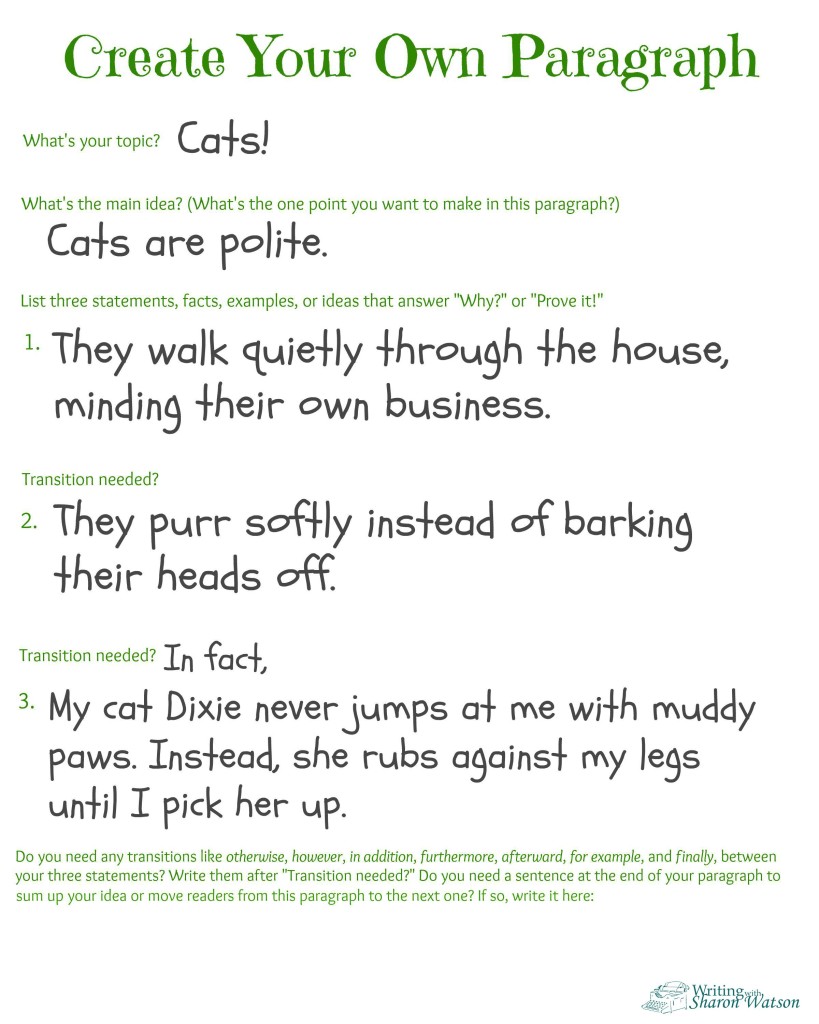
A Filled-in Paragraph Chart This is the paragraph, all written out:
Cats are polite. They walk quietly through the house, minding their own business. They purr softly instead of barking their heads off. In fact, my cat Dixie never jumps at me with muddy paws. Instead, she rubs against my legs until I pick her up.
Notice how the main idea, “Cats are polite,” becomes the topic sentence.
Paragraphs in the body of your essay, not the intro or conclusion, need a topic sentence and two or three sentences to explain or prove your topic sentence. These sentences answer “Why?” or “Prove it!”
You can use examples, facts, logical statements, true stories, and so on. In the cat example, this student uses statements (walk quietly and purr softly) and one example from her own experience with Dixie.
If you are writing an essay, you’ll want to fill out one chart for each paragraph in the body of your essay. Most essays have at least three paragraphs in the body.
After you fill out one chart for each of your paragraphs, move the charts around to see which order you want to put your paragraphs in. When you have decided on the order, write an introduction, then your three paragraphs from your charts, and then a conclusion.
Now it’s your turn: Choose one of the following options.
Do you disagree with the paragraph about cats? Then fill in the chart and write a paragraph about dogs!
Choose an animal you love or can’t stand. Next, think of reasons why this animal would make a great pet (or a terrible one). Then fill out the chart. Finally, use the information you put on the chart to write your own paragraph.
What does it take toHappy family, Image courtesy of photostock, FreeDigitalPhotos.net have a happy family?
“Families that eat together, stay together. It’s that simple,” writes Denise Mann in “15 Secrets of Happy Families” on WebMD.com. Do you agree? Is it really that simple?
Rabbi Shmuley Boteach in the same article suggests this: “Have one or two unifying activities that the family does together on a nightly basis.” This could be reading a story or playing a game together.
When was the last time your shoes talked to you? By using anthropomorphism, meaning “in the form of a human,” you can make objects or animals talk, plan, cry, and do other things humans do.
Did you know you shouldn’t spray Windex in your eyes or put your TV remote in the dishwasher? You did? Create your own warning to include on a product.
It’s easy to compare our homeschools with other educational experiences, but there’s no need to. If you feel inadequate, read this blog and feel cheered by Sharon’s experiences.
You know you have them—those story writers who won’t come out of their bedrooms, the ones who faint at writing essays but love writing stories. They spend hours creating fictional worlds and populating them with characters in trouble who are looking for a happy ending. Fiction is a powerful tool to influence readers’ hearts. Let’s equip…
MIDDLE SCHOOL PROMPTS You see this sweet puppy in the window of the pet store, and you can’t resist. You want to buy him. When you do, he leaps into your arms and licks your face. This little fellow is so happy—and so are you. Now he’s a friend for life. You do everything together….