Today you get to be Shakespeare and write a sonnet.
A sonnet is a poem of fourteen lines. The last two lines, however, are separate and either sum up the rest of the poem or provide a new twist, as does the sonnet below.
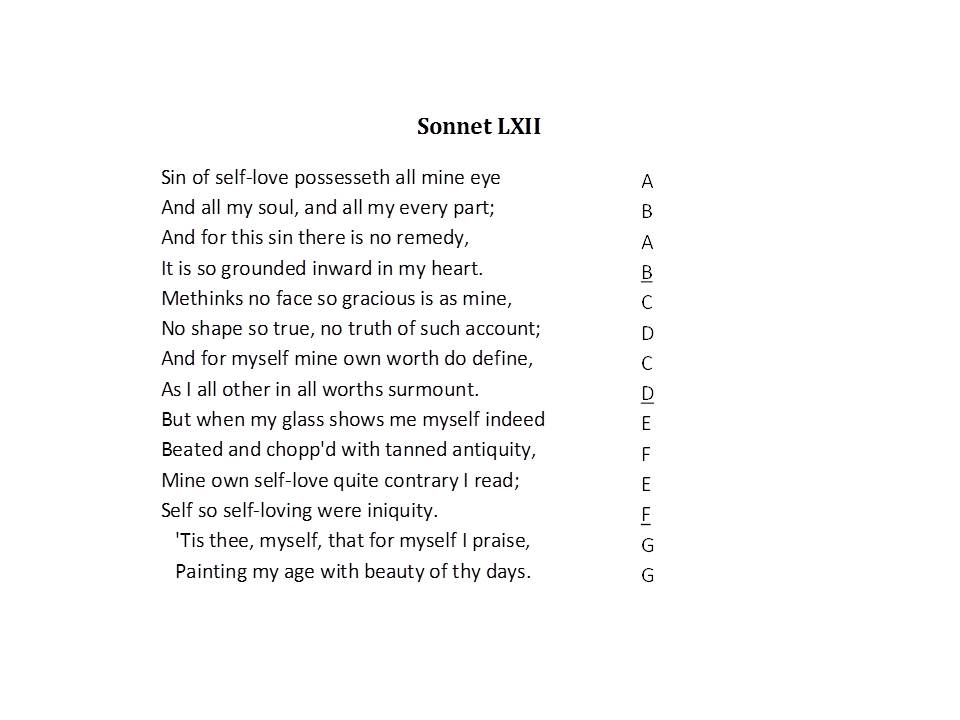
Let’s look at Shakespeare’s Sonnet 62. The letters at the end of each line are Shakespeare’s rhyme scheme, but ignore that for now. Take a few moments and read the sonnet. Then I’ll explain it:
What Does It Mean?
This poet is stating that he loves himself too much and that there is no way to fix it because it is so deeply ingrained. He thinks he is more handsome than others (“Methinks no face so gracious as is mine”) and in great shape. He also declares that he is more important and of greater worth than other people (“As I . . . all worths surmount”). It’s hard not to smile when you read these lines.
But then he walks by a mirror (“glass”) and sees how old, wrinkled, and browned with age he has become. His reflection stops him short. It makes him reconsider his prideful outlook (“Self so self-loving were iniquity”).
The last two lines provide the twist. Here’s a paraphrase of what he’s saying: “When I praise myself, I’m really praising you because you have kept me young. Your love (or friendship) has given me attributes I really do not have without you.”
.
Now it’s your turn: Write a sonnet. Begin by choosing a topic. It can be anything: how much you love your pet, how terrible nightmares are, how good it feels to play your favorite sport, and so on.
Next, write your first twelve lines and mimic Shakespeare’s rhyme scheme in Sonnet 62. His is labeled next to the sonnet.
Last, create the last two lines (a couplet) that either sum up the poem or give it a twist. Those two lines will rhyme with one another.
A version of this prompt was first posted on SchoolhouseTeachers.com. You can go directly to SchoolhouseTeachers.com to sign up and take advantage of many exciting courses written for grades K-12.
Frustrated that your students don’t finish an essay or don’t know the steps to complete one? Worry no more!Click here for my latest article in The Informer about a super-practical writing schedule you WILL use!
[box type=”shadow”] Get three FREE writing lessons by subscribing to Writing with Sharon Watson! Use the Subscribe form in the column to the right.[/box]
Characterization requires giving a character positive attributes and a negative attribute, trait, habit, or failing. The bad guy is even more believable with at least one positive attribute. Create a good guy (or gal) or a nasty antagonist in this high school writing prompt.
HIGH SCHOOL PROMPTS Jail probably isn’t the optimal location from which to pen a letter. If I were to write one from jail, it would probably say, “Get me out of here!” Paul’s Message However, Apostle Paul writes from jail often and exudes no panic. In Philippians, while chained in a Roman prison, Paul tells the…
SHARON’S BLOGAre you looking for a way to focus your students’ minds and hearts on the meaning of Easter? Our special Easter prompts will help your students think deeply on the events and meaning of our dear Savior’s death and resurrection. These 7 prompts are arranged chronologically from Jesus’ Triumphal Entry through Thomas’s epiphany a…
Do you have many activities that keep you rushing from the door to the car? Is your time being gobbled up by the restless speed of your life? Do you find yourself saying, “It will slow down after ____________”? (You fill in the blank.)
Share your common sense and wisdom with this high school writing prompt encouraging you to be the advice columnist. Help a friend through a tough time.
HIGH SCHOOL PROMPTS So you’re driving your taxi, and someone hails you from the sidewalk. In comes a man you eventually recognize, and you get so excited that you shout a phrase from one of his movies to him. He laughs and joins in the fun. You drop him off, but that is not the…