A paragraph is all about one idea. In it, you teach something about that idea, explain it, or prove why it is the right one. One effective question to ask yourself is “What do I want my reader to know about this topic?”
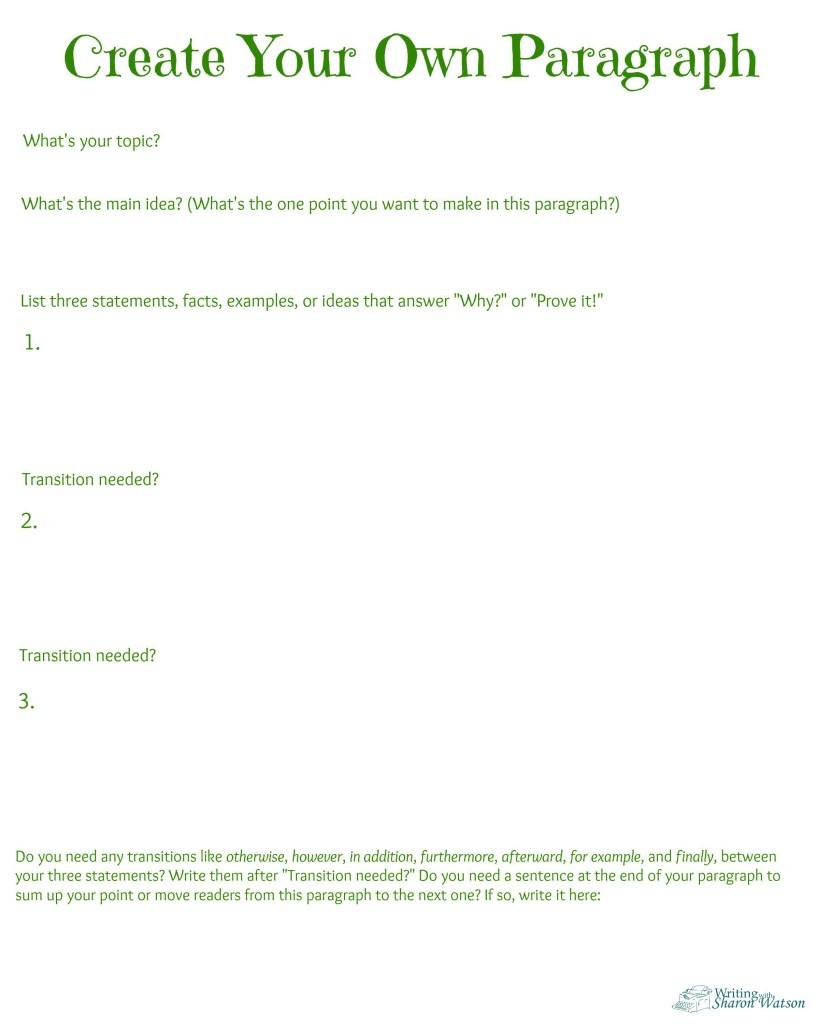
A Note: When one student used this chart to write a paragraph about a type of shark, she saw that she needed a section in her paragraph to describe the shark’s appearance. So she added that between the main idea and the first statement.
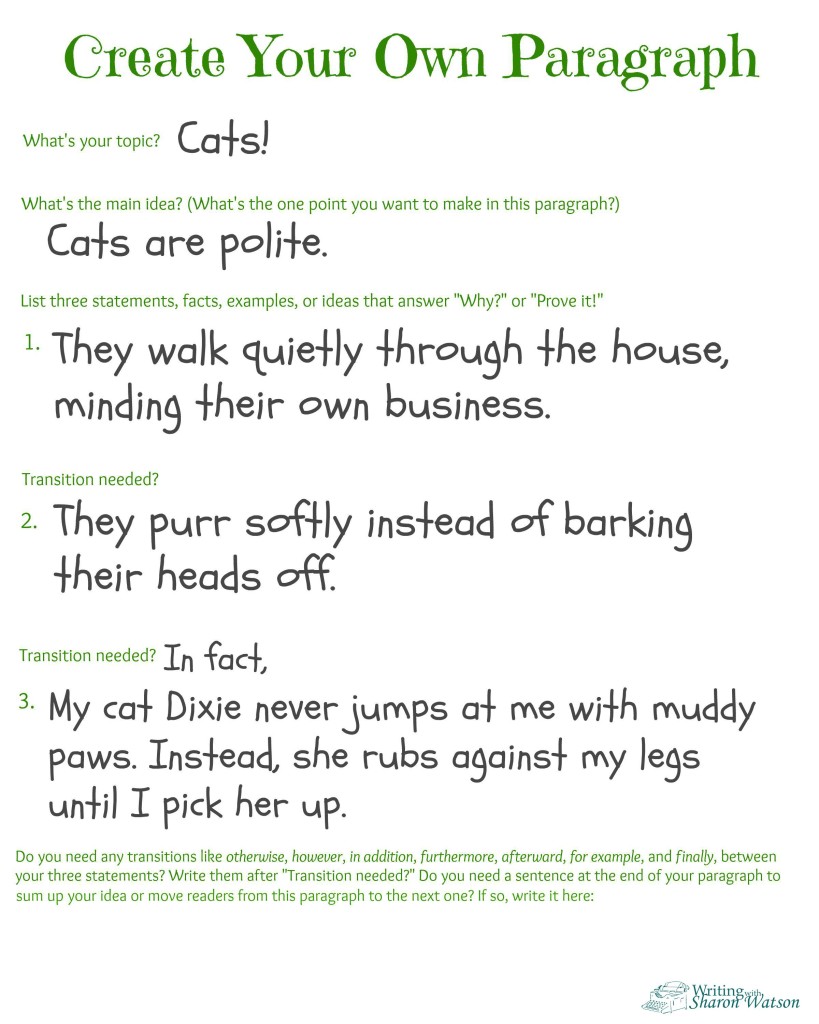
A Filled-in Paragraph Chart This is the paragraph, all written out:
Cats are polite. They walk quietly through the house, minding their own business. They purr softly instead of barking their heads off. In fact, my cat Dixie never jumps at me with muddy paws. Instead, she rubs against my legs until I pick her up.
Notice how the main idea, “Cats are polite,” becomes the topic sentence.
Paragraphs in the body of your essay, not the intro or conclusion, need a topic sentence and two or three sentences to explain or prove your topic sentence. These sentences answer “Why?” or “Prove it!”
You can use examples, facts, logical statements, true stories, and so on. In the cat example, this student uses statements (walk quietly and purr softly) and one example from her own experience with Dixie.
If you are writing an essay, you’ll want to fill out one chart for each paragraph in the body of your essay. Most essays have at least three paragraphs in the body.
After you fill out one chart for each of your paragraphs, move the charts around to see which order you want to put your paragraphs in. When you have decided on the order, write an introduction, then your three paragraphs from your charts, and then a conclusion.
Now it’s your turn: Choose one of the following options.
Do you disagree with the paragraph about cats? Then fill in the chart and write a paragraph about dogs!
Choose an animal you love or can’t stand. Next, think of reasons why this animal would make a great pet (or a terrible one). Then fill out the chart. Finally, use the information you put on the chart to write your own paragraph.
Perhaps you didn’t know you have a Disney side. In this Disney Parks television commercial, you’ll find an older man who shows his Disney side by becoming a Disney character—but at an awkward moment!
Gals, which Disney princess are you most like? Guys, which Disney hero are you most like?
Okay, maybe you don’t have a Disney side, but you certainly are very much like any other number of fictional characters.
HIGH SCHOOL PROMPTS Jail probably isn’t the optimal location from which to pen a letter. If I were to write one from jail, it would probably say, “Get me out of here!” Paul’s Message However, Apostle Paul writes from jail often and exudes no panic. In Philippians, while chained in a Roman prison, Paul tells the…
HIGH SCHOOL PROMPTS Hyperbole is a lot of fun to read and to write. But what is it? Hyperbole (hi PER bo lee) is exaggeration, as in “He was as hefty as a whale” or “Her whining voice so electrified the air that it knocked migrating geese off their course.” To read examples of this figure of speech, click…
SHARON’S BLOG Your child has just handed you a completed essay, and you are ecstatic . . . until you realize you now have to grade it. Where do you begin? How do you evaluate this marvelous gift? Grading Essays Welcome to this exciting, first-in-a-series blog about grading your middle and high school students’ essays!…
No, this isn’t a fun-loving film about Caribbean pirates and Johnny Depp. I’m talking about real pirates with lethal weapons who board your boat, take you captive, kill your crew, and hold you for ransom. That kind of pirate. They’re very real, and they’re very active off the shores of South America and Africa.
Being captured by real pirates is exactly what happened to Captain Richard Phillips in 2009. Captain Phillips, a movie of his harrowing experience, comes out October 11 with Tom Hanks playing the captain.
What did Phillips think of his experience? In a Parade interview of September 22, 2013, Phillips says this about fear
SHARON’S BLOGSaint Patrick’s Day is a great time to encourage the thinking process in your students, and these two prompts are here to help. Younger students will enjoy the categorizing and attention to words in this prompt. A free printable is included. Older students will read of two examples and then use something concrete to…