Today you get to be Shakespeare and write a sonnet.
A sonnet is a poem of fourteen lines. The last two lines, however, are separate and either sum up the rest of the poem or provide a new twist, as does the sonnet below.
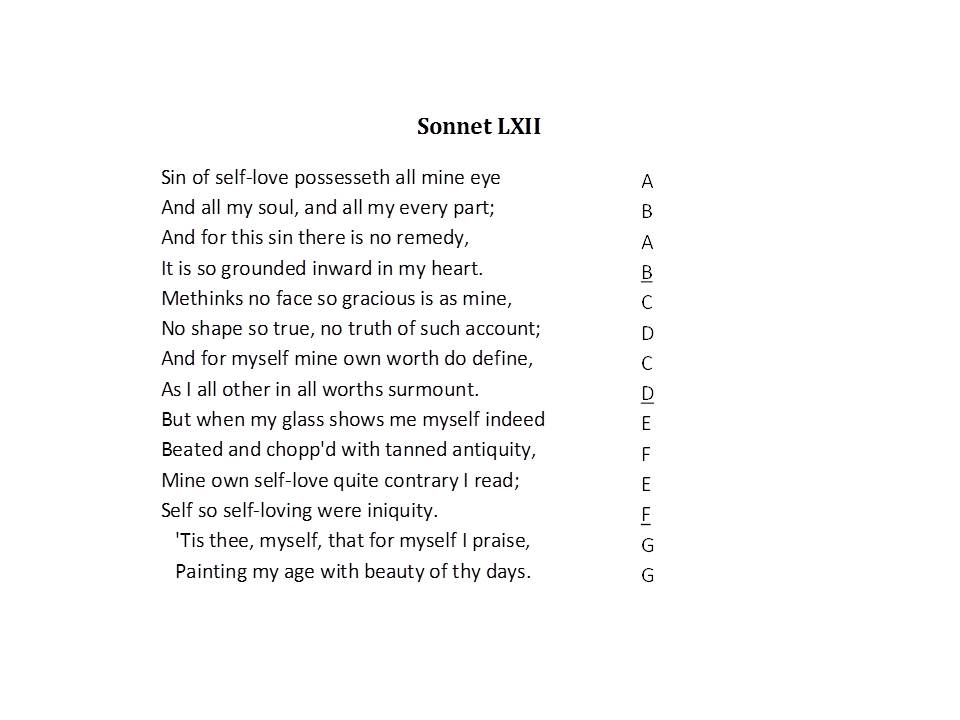
Let’s look at Shakespeare’s Sonnet 62. The letters at the end of each line are Shakespeare’s rhyme scheme, but ignore that for now. Take a few moments and read the sonnet. Then I’ll explain it:
What Does It Mean?
This poet is stating that he loves himself too much and that there is no way to fix it because it is so deeply ingrained. He thinks he is more handsome than others (“Methinks no face so gracious as is mine”) and in great shape. He also declares that he is more important and of greater worth than other people (“As I . . . all worths surmount”). It’s hard not to smile when you read these lines.
But then he walks by a mirror (“glass”) and sees how old, wrinkled, and browned with age he has become. His reflection stops him short. It makes him reconsider his prideful outlook (“Self so self-loving were iniquity”).
The last two lines provide the twist. Here’s a paraphrase of what he’s saying: “When I praise myself, I’m really praising you because you have kept me young. Your love (or friendship) has given me attributes I really do not have without you.”
.
Now it’s your turn: Write a sonnet. Begin by choosing a topic. It can be anything: how much you love your pet, how terrible nightmares are, how good it feels to play your favorite sport, and so on.
Next, write your first twelve lines and mimic Shakespeare’s rhyme scheme in Sonnet 62. His is labeled next to the sonnet.
Last, create the last two lines (a couplet) that either sum up the poem or give it a twist. Those two lines will rhyme with one another.
A version of this prompt was first posted on SchoolhouseTeachers.com. You can go directly to SchoolhouseTeachers.com to sign up and take advantage of many exciting courses written for grades K-12.
Frustrated that your students don’t finish an essay or don’t know the steps to complete one? Worry no more!Click here for my latest article in The Informer about a super-practical writing schedule you WILL use!
[box type=”shadow”] Get three FREE writing lessons by subscribing to Writing with Sharon Watson! Use the Subscribe form in the column to the right.[/box]
Many reasons exist for someone not speaking. For instance, someone may be afraid to speak and be an elective mute. Some may have been born with physical problems that make it difficult to speak. Others may have lost the ability to speak due to an illness, which is what happened to Don in this video. Watch it and choose a writing prompt.
HIGH SCHOOL PROMPTS So you’re driving your taxi, and someone hails you from the sidewalk. In comes a man you eventually recognize, and you get so excited that you shout a phrase from one of his movies to him. He laughs and joins in the fun. You drop him off, but that is not the…
HIGH SCHOOL PROMPTS A story’s point of view (POV) can affect how the story feels. For instance, The Magician’s Nephew by C. S. Lewis is written in the third-person omniscient POV: The narrator knows everything, even things that some of the characters do not. The invisible narrator in omniscient POV can tell readers what one…
Some kids hate writing essays, and off the top of their heads they can give you 97 reasons why this is so. When I teach my writing course locally, some students are bound to come to the first class with a “don’t even bother trying to teach me” attitude. They believe they are so far gone that they are unteachable.
HIGH SCHOOL PROMPTS Do you know how much we owe to William Tyndale? He knew he could be killed for what he was doing, but he did it anyway. Tyndale translated the Bible in the 1500s from Latin into the people’s English so they could understand it, and it cost him his life.