Your 5 Senses: Writing Prompts
Using your five senses can enhance your writing more than you might think possible. Here’s a successful author to tell us about it:
“Fiction operates through the senses. . . .The first and most obvious characteristic of fiction is that it deals with reality through what can be seen, heard, smelt, tasted, and touched.”
–Flannery O’Connor
Stories are experienced through our senses. So are personal narratives, description essays, and other modes of writing.
Think of Lucy slipping her hand into Aslan’s fur in a special moment in The Lion, the Witch, and the Wardrobe, feeling the warmth of his presence.
Here are some examples of using senses, taken from The Return of the King by J. R. R. Tolkien:
“There came a long rolling of great drums like thunder in the mountains, and then a braying of horns that shook the very stones and stunned men’s ears.” [sound, feeling]
“The stench of the sweating orcs about him was stifling, and he began to gasp with thirst.” [smell, feeling]
Sharpen your own senses and make your writing come alive as you dip into the over 20 writing prompts below.
Smell
1. You are going to use your sniffer. Visit each room in your house or apartment and SNIFF! Then write down what you smelled in each room.
2. You smell smoke and decide to trace the scent to its source. Write about what happens next.
3. Someone has just given you a diffuser as a gift. A diffuser circulates scents into the air, often by way of scented oils.
What scent will you put into your diffuser? Write an advertisement for the scented oil or combination of oils you selected to use. Your ad will be on the side of the small box that the oil comes in, so you only have a few sentences in which to capture your customers and entice them to buy this particular scent.
*****
Taste
1. You own a restaurant. Choose one of the following:
What kind of food is your specialty? Write about it
Write a menu description for a specific entrée so people will want to order it.
2. List all the foods, snacks, fruits, drinks, spices, and flavorings you eat that begin with the letter “P.”
3. Make a list of three foods that taste better than they look. Now try to convince a friend to eat one of them.
4. Hot dogs hot off the grill. Watermelon. Ice cream. Corn on the cob.
What food says “summer” to you? Write it here: ________________________.
Now write up a description of it as though it were a menu item. Make people yearn for it. Make their mouths water!
5. For a fun example of how to describe the taste of cheese, click here.
*****
Sight
1. Colors and images on flags have meaning. For instance, blue can mean peace or freedom. Red can represent courage. Green can indicate the earth or farming, while yellow can symbolize wealth, the sun, or even justice.
In this way, colors become symbols: something ordinary that can mean something beyond itself, like a wedding ring symbolizing eternity.
Images, too, can be symbols. Stars can mean enlightenment. A bear could stand for strength or ferocity. A tree can mean protection or strength, and a bee can symbolize industriousness (like being as busy as a bee).
Develop a flag for your own family. Use colors, animals, and other items for what they mean to you.
2. Look around you: this room, this day, these people, those possessions or items, that music. In 15 years, what do you think you will remember about today?
3. If you could have an artist paint a picture for you, what would you have the artist paint?
4. Go outside and look up at the sky. What do you see?
Record what you saw. If you saw clouds, don’t write “clouds.” Describe what kind of clouds you saw. For instance, were they light and fluffy but flat on the underside? If you saw birds, describe what they looked like, sounded like, and acted like. Be observant and specific about what you saw.
If you cannot go outside, look up! Record what you see above you inside.
5. Someone has just given you a camera with the instructions to take pictures of things that are important to you. What will you take pictures of?
*****
Sound or Hearing
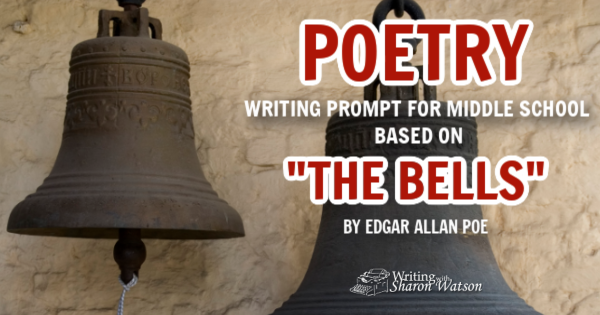
1. Read Poe’s poem “The Bells” out loud. This delightful poem moves from the high, jingling sound of silver bells to “mellow wedding bells” to “brazen” bells sounding an alarm. Then the bells sound even deeper: tolling iron bells that tell of bad news.
When you read the poem, start with your voice up high for the jingling bells and end with your voice very low and deep with the bad-news iron bells.
After you finish that, write your impressions of the poem or of the messages of the different kinds of bells.
2. Sit in your bedroom, in another room in your house, or somewhere outside. Close your eyes for ten minutes and then write down all the sounds you heard.
3. Is there anywhere near your house or town where you cannot hear any manmade noises? If you could go there, would you? Explain.
4. Someone next door is playing the piano very badly. Describe how it sounds and what it feels like to listen to it. Include similes (“like a cat screaming”) and metaphors (the sound = a storm: “The storm thrashed and crashed”).
5. When you are up in a hot air balloon, you can hear things from the ground surprisingly well. You can hear conversations clearly and even can hear deer crashing through the woods.
Imagine you are up in a hot air balloon. What would you see and hear from there? What do you wish you could see and hear from there?
*****
Touch or Feeling
1. Have you ever had a toothache or broken a bone? Describe how it felt. Use as many vivid verbs as you can (pulsed, throbbed, and so forth). If you have never had a toothache or broken any bones, use your imagination and describe what you think it might feel like.
2. Jack London is the author of White Fang and The Call of the Wild. In his short story “To Build a Fire,” London writes of a man traveling in the winter in the Yukon (in Canada, just east of Alaska). How cold was that winter? “One hundred and seven degrees below the freezing-point” or minus 75 degrees!
This man battles extreme cold, frostbite, loneliness, icy build-up on his clothing, wet and then frozen clothing and skin when he breaks through the ice into a stream, his fire being doused by snow plopping from tree branches, and so on. This is not a story you want to read when you are cold!
Write a story of someone trying to do something in the cold. Where are they? What are they trying to do? Why are they trying to do it? Will they be successful?
3. Go around your house and touch smooth things. Drinking glasses, ice cubes, and tile floors come to mind for items in the kitchen.
You will notice that, even though these items are smooth, they do not all feel the same to your hand.
Make a list of five smooth items you touched in your house. Then write one or two words other than “smooth” for each of those smooth items to describe how they felt to the touch.
*****
Multiple
You know spring has truly arrived when you smell ___________________________ , you see ________________________________, you hear __________________________________ , and you do this: ______________________________________________.
Fill in the blanks with your answers that prove to you that spring has finally arrived.