
Proofreading Marks and How to Use Them
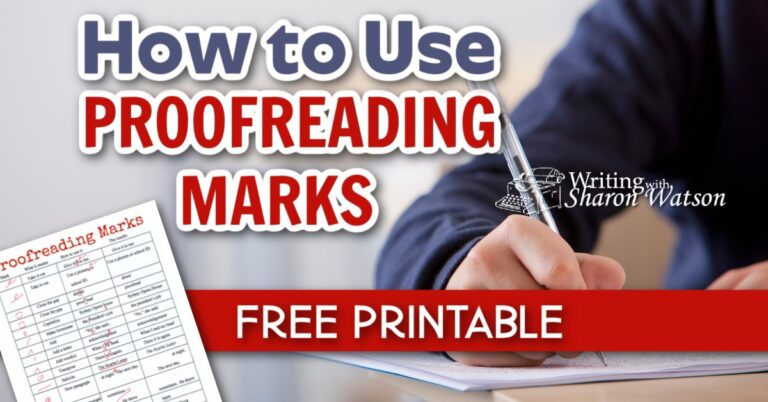
This tutorial shows your students the universal proofreading marks and how to use them. Plus, you’ll get examples and an exercise to reinforce the information.
It’s tough to come up with ideas for essays. Where do you find the topics? Try this strange way of developing ideas for essays using your own initials!
The word “everyone” is singular, so writing “Everyone had their flu shots” is grammatically incorrect. How do we fix this in a gender-neutral language? Use this tutorial to teach your students how to use singular indefinite pronouns and gender-neutral language.
What do your students do if their sentence is a question (interrogative) but there’s already a question mark in the quotation? Use this tutorial to show them how to handle those end punctuation marks.
Students can be baffled by punctuation. Here’s a tutorial on how to use end quotation marks with commas, periods, colons, and semicolons. Let’s make it easy!
I’m sharing this infographic with you to use with your students as you teach the sticky, dull, boring subject of when to use commas in a compound sentence that is joined by a coordinating conjunction. After the infographic, you’ll find an exercise you can give your students to reinforce the material they’ve just learned. The answers follow the sentences.
It’s easy for our students to make these common mistakes in persuasive writing. Here’s a practical list of three mistakes you can help them avoid. Then enjoy the writing activity that follows.
The Florida Everglades is being threatened by new and invasive species of plants and animals that have no natural predators. Write your solution to this problem.
Introductions can be boring. Super boring. Learn how your students can powerfully engage their readers with this writing super power in their introductions.
Interviewing someone is an incredible way to experience real, living history. Learn how to interview someone and then write it into a narrative essay.